
When it comes to marketing, one of the most common mistakes that people make is not being clear on exclusions, or terms and conditions, related to services or offers that they have incorporated as part of their offering.
This isn’t just frustrating for customers, but also for the businesses when customers start calling and asking for things that aren’t included.
With any service or offer that you are promoting, you should always be very clear in any exclusions or limitations that are applicable to that offer. The ability to do this provides both an ability for you to manage customer expectations and a way limit any risks to yourself, but you need to consider these first and provide details in any marketing that you do.
What should you include?
The types of elements that you should always include and ensure you inform customers of are:
The offer: in simple terms, I am willing to do this / give you this, based on you meeting certain criteria. Include all of the specific information such as, if you are promoting a red blanket for $49 – what’s the size of the blanket, what’s it made of, where is it available, till when. Or, if you are offering something for free – what do you need to buy / do to get the free thing, what is the free thing, when do you need to respond buy.
Expiry date: we wrote in an earlier blog about the importance of having time based offers.
Restrictions: whether it’s a restriction to a service or a promotion, you should always be clear. Things such as limited stock, first number of customers to respond, minimum size, pricing and value restrictions, quantity to be purchased are all examples of restriction criteria that customers must meet in order to receive an offer. From a service perspective, restrictions could include maximum distance traveled, minimum labour time, or minimum fees.
Exclusions: exclusions are important if you are promoting broad sale discounts or product offers. If you’re running a sale promotion, you might want to exclude already discounted items, or if you are offering “free” items their might be value restrictions, new or specific ranges might be excluded.
These are just examples but provide you with ideas on the types of considerations that you need to be aware of when preparing offers, and what information customers should be told.
And now for the fine print….
When people develop marketing material it’s a common mistake for the creativity to take control and then the important information becomes secondary.
Let me introduce you to fine print!
I HATE IT…and I probably speak for many customers (and lawyers) who hate it to!
Too much fine print can make people question what you are really offering. All too often the fine print is hidden well below the key message, printed in a size that you need a magnifying glass to see properly.
Now I’m not saying that you shouldn’t include fine print. That’s just not practical. There is certainly going to be times where fine print is required, especially when there are legal considerations such as finance and accreditation details. What I am making reference to is hiding the important customer information in the fine print. With many things it’s not necessary – you should be able to bring the important information up front. All too often I watch TV ads, listen to radio or review a voucher where the fine print is where I find all of the necessary detail to help me make a decision or, it’s missing entirely. This can cause you many issues including lack of response, grumpy customers and legal issues which you don’t want your business exposed to. I was once given a copy of a promotion that was sent out to customers (via letterbox drop so assume no relationship) which didn’t include an offer date. I was shown this material because, 8 years later, a customer attempted to redeem the offer as the material was still relevant to products that were available now. Albeit cheeky (you could tell that the material was quite old) the customer had a right to ask for that. Inflation and CPI over 8 years meant that the pricing was significantly different now however, this promotion had excluded the offer expiry meaning that the customer had a right to request the pricing and the business had an obligation to honor it. You can always argue and dispute this however, is it worth the effort?
It’s worth putting the effort in up front to ensure that what you are doing is right and complete to ensure the integrity of your campaign.
So, let’s look at this in practical terms.
Here is an example of a voucher (re-drafted so as to not offend).
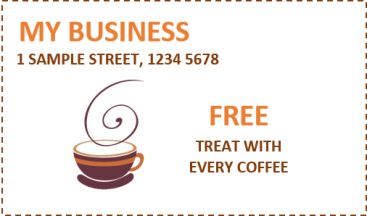
I buy a coffee and I get a treat.
Great!
I wonder what the treat is. I don’t really feel like a treat today, may be I will just put this in my wallet and come back another day.
I have another coffee shop around the corner to. I might keep going there for now.
You can probably see the challenge. One of the disappointing things is that the objective of most vouchers is to create an incentive to purchase. This voucher was provided to me at the time after purchase, so to encourage repeat purchase allowing the business and I to start to build a relationship with the potential of some form of long term commitment. This voucher didn’t do that as it failed for me to see urgency and was too vague to allow me to start thinking about how nice a “treat” would be with my coffee.
This is where the exclusions and restrictions can help to not only provide the safety net for the business, but to help deliver on marketing performance.
Here is an alternative, with fine print.
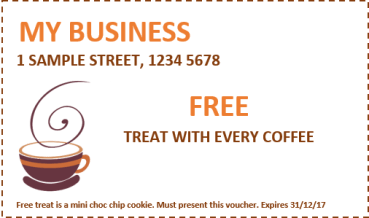 Wow, so if I read the voucher there’s a bit more information that will help me with my decision. Hmmm, dunking a choc chip cookie into my coffee certainly sounds good. I know also that I have to have the voucher present and I also need to return by a certain time. I haven’t gotten past the dunking of the choc chip cookie so it looks like I’m going to have make sure I’m going to have to come back tomorrow and get another coffee. I might also bring a friend.
So, this voucher has provided me with some more information, but I had to read it. Good thing I did but I had a bit of time today, some days I don’t and just miss reading the detail and I mentioned earlier that I do hate fine print, so let’s try another option:
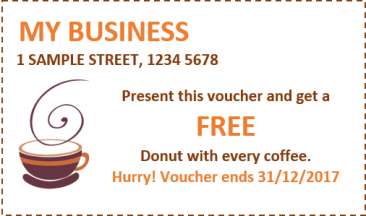
NO FINE PRINT!
By making the restrictions and exclusions as part of the offer, they become part of the key message which helps to make it clearer for the customer and it also strengthens the offer.
I believe that this is much more enticing and appealing for the customer. From a marketing perspective, it can take more time to tweak the message and get the offer right but, once you get there, it’s going to be worth it! Having a strong and clear offer will also increase responses and will also make sure that you are starting your new customer relationships off on the right foot.
Now, I know this isn’t always possible however it should be a firm goal that, whenever you are working on putting together marketing material, offers or service based, that you are upfront with the customer, that you build a strong message with zero ambiguity and, of course, you use the right channel to communicate to the right customer.
I hope that you’ve found this informative.
Good Luck.
The Marketing Elf
© November 2017
All information provided here is to be used as a guide only. No material is to be shared or re-published without permission.
 The Marketing Elf