
 One of the habits that many small businesses can find themselves in is just rotating the same marketing activity over month on month, year on year, without doing a proper business assessment on whether it’s working. An assessment can be simple but also very enlightening – and it’s important in small business to ensure that every cent is driving a positive outcome. Once an assessment has been completed, the outcomes can help to build the strategic roadmap for the business to move ahead.
What is a marketing roadmap
A roadmap is a simple but yet very important tool that is used to help set goals and maintain focus for the business and staff. To develop a roadmap, you really need to delve into the true operations of the business
Why is it important?
I recall working with a small retailer once who was allocating a lot of their marketing spend to local area marketing. They were struggling with foot traffic but didn’t have the funds available to drive strong acquisition marketing because their funds were already allocated. I spent time and sat with them analysing exactly where this marketing spend was going and whether it was driving returns. Upon assessment, 85% of their spend was on local sponsorships and donations that did not have any leverage agreements or opportunities. This was great for their community, but not so great for them as they were struggling to drive traffic and sales to their business and it was having a toll on their profitability, and confidence. This is where assessments can really drive outcomes and change, to help move the business forward, creating a road map for success.
Where to begin
For marketing, many assessments focus on looking at the sales outcomes achieved from activity but, in small business, I prefer to start by looking at total spend. Total spend for marketing activity isn’t just about media spend – you need to cover and recognise everything that you use to help drive marketing activity and group it in to categories. Sales outcomes is very important, and we will get to that if you aren’t already doing that after every campaign, but starting an assessment
- Grab a copy of your expense sheet, hopefully you have all your marketing allocated to either a single ledger or an expense card, and sort the transactions by month to allow you to get in to the granular detail.
- Create an excel spreadsheet that you can input the costs into. Below is an example of a simple one that you could apply
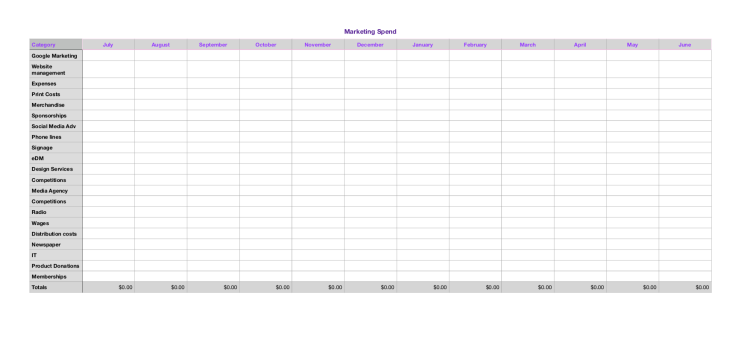 Once you’ve created your spreadsheet, you can then start auditing your spend.
Things to consider in addition to media could be:
- Memberships: subscriptions to magazines; online tools such as productreview.com.au; systems used to create marketing (i.e. your email system). Consider places or schemes that you belong to which are used to development marketing;
- Website costs: websites cost a lot less than they previously did however there are hosting costs or ongoing management costs (if outsourced) that you need to capture
- Wages / resource costs : whether you are using a contractor or full time team member, you need to capture the costs accurately
- Phone costs: mobile or fixed, you are likely to have a phone line that people call to respond to marketing
- IT: any system that supports your marketing function needs to be captured as a marketing cost
Depending on your business, there are other costs that you could add. The key is to make sure that you recognise your true cost of marketing in your business internally and externally. This will help you understand your full return on investment rather than just your advertising return on investment.
3. Analyse every little detail! Once you’ve captured all of your costs, you need to look into every spend and identify whether it’s too high an investment proportionate to the rest of your spend. As with the example above, if you aren’t allocating spend to the right areas this can leave you at risk of not achieving your business goals and even putting your business at risk. Marketing can be very expensive so every cent counts. If you aren’t spending it on the right things, you are essentially wasting your precious earnings and, in small business particularly, this is money that you have personally worked hard to bring in. You need to make sure that every cent you spend right one.
Once you’ve finished analysing your spend, you now have the opportunity to look forward and make some fundamental changes to what you’ve been doing. This isn’t saying that what you’ve been doing is wrong but it’s a great chance to make improvements.
Using your analysis, set a budget to move forward with. Identify the areas that you want to spend money and the ones that will drive your return.
Where you have identified overspend which is related to supplier costs or external providers, nows a great time to investigate your obligations. If you are in contracts with them, see if there are alternative options or, if you have the freedom to explore different suppliers, it’s a great time for change. Your money and account is invaluable and you need to partner with the right businesses who respect you and your business.
Remember that it’s not only about spend and you might find that you need to get a different solution that might cost more but if it achieves a better outcome, this might offer you a better alternative. Now that you have the foundations of a budget, you can then make sure that you are able to spend where you need to.
All of this may sound like a lot of work but understanding where your money is being spent is a great foundation to success. Once you know how you’ve done it previously, you can learn and set direction, you might even be surprised at where the majority of your spend falls.
Once you are satisfied that you’ve captured everything, you are ready to move to building a marketing activity calendar. We will cover this off for you in an upcoming blog.
Good Luck!
The Marketing Elf
September 2018
 The Marketing Elf
One thought on “Marketing roadmap step 1: assessing your spend.”